|

Objectives
This tutorial
aims to familiarize you with the following principles of colourimetry:
Why
Use Colourimetry?
Colourimetry
can yield a wealth of information on coloured solutions. It is a quick and non-destructive
method that can identify solutes in a solution and very accurately determine
their concentrations. Computer technology has automated the somewhat tedious
calculations required for colorimetric analysis and now allows colourimetry experiments
to be performed within the span of a few minutes from start to finish. In short,
a colorimetric analysis is straightforward, relatively foolproof, and highly
informative.
How
Does Colourimetry Work?
Colourimetry
is a form of spectroscopy, an analysis that measures how atoms or molecules
respond when exposed to electromagnetic radiation of a certain wavelength, and
therefore, of a certain energy. In a way, colourimetry is the most familiar kind
of spectroscopy, because the wavelengths used are from the visible
light region of the electromagnetic spectrum.

The
electromagnetic spectrum; note the visible light region in the middle.
Radiation from this region is used in colourimetry. Illustration from NASA.

The
relation of a wave's energy, E, to its wavelength, the Greek letter lambda.
Energy is inversely proportional to wavelength.

The
energy/wavelength relationship in the electromagnetic spectrum. Energy
increases right to left; wavelength decreases right to left. Illustration
from NASA.
|
In colourimetry,
a light wave of a certain wavelength and intensity is shined at a solution (this
is called incident light). The intensity of the light exiting the sample (transmitted
light) is measured on the other side of the sample. By comparing the incident
intensity to the transmitted intensity, the absorbance, A, can be determined
for that wavelength of light. More precisely, A = -log(I/I0), where
I is the transmitted intensity and I0 is the incident intensity.
A vast majority
of the light that has not been transmitted through a translucent sample is absorbed
by the sample (a negligible fraction of the energy is lost to scattering). Therefore,
a substance that transmits most of the light at a particular wavelength will
have a low absorbance at that wavelength. These measurements are repeated at
many different wavelengths of light from the visible region of the spectrum.
An absorbance
spectrum is created by plotting absorbance versus the light wavelength. For
example, a red-coloured sample will transmit large proportions of light at wavelengths
near the red range and exhibit a low absorbance at that wavelength. However,
it will absorb more (and transmit less) at all other wavelengths. Shown below
to illustrate this property is a spectrum of FD & C Red 40, one of the food
dyes that you will be analyzing during the experiment. Note the markedly low
absorbance at the higher, red-coloured wavelengths on the right.
These spectra
are characteristic of a particular chemical substance, and can be used to identify
unknown solutions by comparison to the spectra of known solutions.
Question 1
At the top
of the table displayed below is an absorbance spectrum of an unknown substance.
Below the unknown spectrum are the absorbance spectra of four candidate substances
that may be the unknown. Identify the unknown using the shape of its absorbance
spectrum.
|

Unknown Sample
|

FD &
C Blue #2 |

FD &
C Red #2 |

FD & C Yellow
#5 |

FD & C Yellow
#6
|
The colour of a dye molecule depends on its structure, particularly on the grouping of certain atoms called "chromophores". Different chromophores absorb light at different wavelengths, giving rise to a variety of colours. Sometimes two dyes may contain the same chromophore and differ only in groups of atoms attached to that chromophore. The colours of these dyes are very much alike and difficult to tell apart visually. However, the minor structural differences are sufficient to produce subtle differences in the absorbance spectra of these dyes. Consider the structures of two dyes, Blue #1 and Green #3, provided below. Can you tell what the only difference is in the structure of these two dyes?
|

Blue #1
|

Green #3
|
Since similar dyes have similar spectra, you have to carefully compare the spectrum of your unknown to the spectra of known dyes with similar colour. In the laboratory, the program called ColourMixer displays spectra of three dyes on the computer screen at the same time, making the identification process quick and accurate.
In the spectrum below, is the Unknown dye Blue #1 or Green #3?
Notice that the highest bar appears at 620nm in the spectra of both Blue #1 and Green #3. Therefore, the identification is best achieved by comparing the relative heights of bars on both sides of that bar. This would be the bars at 605 and 644 nm in the spectra of the Blue #1 and Green #3.
Once an absorbance
spectrum of a particular substance is available, and the identity of the substance
has been established, its concentration in solution can also be measured by
colourimetry. This analysis is based on Beer’s Law, which in simple terms
relates the colour intensity of a solution to its concentration. More precisely,
Beer’s Law states that A =  l
c, where A is the absorbance of the sample, is
a substance- and wavelength-specific coefficient, l is the
length the light travels through the sample, and c is the sample’s
concentration. The box below summarizes the relationship of incident and transmitted
light intensities, absorbance, and the concentration of a substance in solution. l
c, where A is the absorbance of the sample, is
a substance- and wavelength-specific coefficient, l is the
length the light travels through the sample, and c is the sample’s
concentration. The box below summarizes the relationship of incident and transmitted
light intensities, absorbance, and the concentration of a substance in solution.
First, the
wavelength of maximal absorbance is chosen from the substance’s absorbance
spectrum. This is called the analytical wavelength and is the wavelength at
which Beer’s Law analysis is done.
Question 2
For each
of the substances shown below, locate and state the analytical wavelength. What
colour does each wavelength correspond to?
FD &
C Blue #2 |
FD &
C Red #2 |
FD & C Yellow
#5 |
FD & C Yellow
#6
|
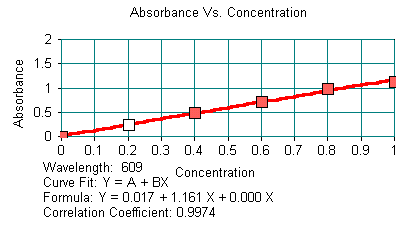
A series
of solutions of the substance with known concentrations are prepared. The absorbance
of these solutions at the analytical wavelength is measured in sequence. When
the measured absorbance values are plotted versus the solution concentrations,
a straight line can be drawn to connect the points. This is because A
= l
c, and
and l are the same for each sample. Thus A
varies linearly with c. This plot is called a calibration graph.
Shown below is a calibration graph for FD & C Blue #2.
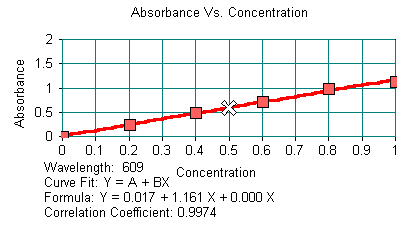
Next, the
absorbance of the sample of unknown concentration is measured. This absorbance
value corresponds to a concentration on the calibration graph: this is the concentration
of the unknown. In the graph below, the absorbance of a sample of FD & C
Blue #2 of unknown concentration is measured at the analytical wavelength and
placed on the graph (look for the X mark).
A computer
calculates the unknown's relative concentration from the graph by fitting it
into the equation of the red line. The unknown's concentration turns out to
be 0.499, or 49.9% of the concentration of the standard sample marked 1.0.
Proper
Experimental Technique
Before acquiring
any absorption or transmission spectra of your samples, calibrate the colorimeter
by taking a reading with a clean cuvet filled with deionized water. The colourimetry
software will set the absorbance of this “blank” to zero: for the
blank, I=I0.
Before doing
any Beer’s Law calculations on a solute of unknown concentration, you
must first identify the solute. This is done by matching its absorbance spectrum
to that of a known chemical substance. Beer’s Law holds only for absorbance
values below 2, so there is a good chance that you will need to dilute your
substance in order to obtain meaningful measurements. The spectrum of undiluted
blackcurrant Powerade, shown below, is an example of when this is the case.
Note the astronomical absorbance values!

Blackcurrant
Powerade, Undiluted |
Question 3
Beer's Law
holds for absorbance values below 2. What minimum value of I/I0 does
that represent? (What is the minimum relative intensity of the transmitted light
compared to the incident light?)
When performing
your dilution, remember that quantitative accuracy will be required for subsequent
Beer’s Law calculations, even though it is not necessary to identify the
substance. Thus, it is wise to keep careful track of your dilutions for future
Beer’s Law calculations.

Blackcurrant
Powerade, Diluted Tenfold. |
Observe the
spectrum of your (diluted) unknown, and locate the highest peak. This is the
analytical wavelength. If the spectrum has two or more high peaks separated
by a valley, this may mean that your sample contains more than one dye. In our
blackcurrant Powerade example, after diluting the beverage tenfold and reacquiring
the spectrum, we have good reason to suspect that this is the case.
 |

|
Blackcurrant
Powerade, Diluted Tenfold
Note
two potential analytical wavelengths, at 502 and 609 nm. This indicates
that more than one dye may be present in the beverage being analyzed. |
A quick run
of paper chromatography will tell you if this is the case. If so, use column
chromatography to separate the dyes and perform the above analysis on each one.
Remember: you cannot do Beer’s Law calculations on column eluates! The
concentration of your eluted products has nothing to do with their concentration
in the sample that is loaded on the column! Therefore, the eluted products can
only be used to identify the constituents of the sample, and
not to determine their concentrations.
To identify
the unknown solutes, compare their individual absorbance spectra to those of
known “suspect” dyes. If the shapes of the spectra match perfectly,
you’ve successfully identified your unknowns. Shown below are absorbance
spectra of red and blue coloured fractions from blackcurrant Powerade that have
been separated by column chromatography. Remember that these fractions are not
suitable for Beer's Law analysis, since their concentrations in relation to
the original sample cannot be precisely known.
|

|
 |

|
 |
Blackcurrant
Powerade Red Fraction
Note
analytical wavelength of 502 nm and compare to spectrum of diluted blackcurrant
Powerade.
|
Blackcurrant
Powerade Blue Fraction
Note
analytical wavelength of 621 nm and compare to spectrum of diluted blackcurrant
Powerade.
|
Once your
unknown has been identified and its analytical wavelength(s) established, you
can determine the concentration of the dye(s) in your unknown. The dyes
do not need to be separated for this analysis as long as their analytical wavelengths
are sufficiently different. As long as this is the case, it is perfectly
acceptable to perform Beer's Law calculations on the mixture at each dye's analytical
wavelength.
For
each analytical wavelength (and dye), do the following:
Prepare a
set of samples of the dye of known concentrations. This is best done by taking
a stock solution of the dye and diluting it to, say, 0.2, 0.4, 0.6 and 0.8 of
the initial concentration. Be careful when making your dilutions! The accuracy
of your technique here will affect the accuracy of the Beer’s Law calibration
graph and of your calculated unknown concentration.
|

FD & C Red #2
Calibration Series
|
Using the
colourimetry software interface for making a calibration graph, acquire measurements
of each of your dilutions and of the undiluted stock solution at their analytical
wavelength. Then, acquire the absorbance of your (precisely diluted) unknown
at that wavelength. The computer interface will automatically calculate its
concentration relative to the stock solution from the equation of the calibration
graph. With knowledge of the stock solution’s actual concentration, the
unknown’s concentration is easily calculated.
Summary
This tutorial
on colourimetry has presented the following topics:
- The advantages of colourimetry
as an analytical technique.
- The laws of physics and
chemistry underlying colourimetry.
- Experimental technique
for identifiying solutes and measuring concentrations by colorimetric analysis.
|