| Learning Goal 1 |
|---|
| List the characteristics of acidic and basic solutions, and identify the ions responsible for these properties. |
Acids are generally a class of substances that taste sour, such as vinegar, which is a dilute solution of acetic acid. Bases, or alkaline substances, are characterized by their bitter taste and slippery feel. The first precise definition of an an acid and base was given by Svante Arrhenius, and is referred to as Arrhenius Theory.
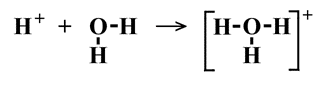
The hydrogen ion interacts strongly with a lone pair of electrons on the oxygen of a water molecule. The resulting ion, H3O+ is called the hydronium ion.
The reaction of HCl with water can be written in either of the following ways:
The Brønsted-Lowry Concept of Acids and Bases
| Learning Goal 2 |
|---|
| Define Brønsted acid and Brønsted base and conjugate acid-base pair. Identify the conjugate base associated with a Brønsted acid, and the conjugate acid associated with a given Brønsted base. |
So, in the example above, HCl acts as a Brønsted Acid by donating a proton in water, and water in turn acts as a Brønsted Base by accepting a proton from HCl. (as shown in this animation).
Water can act as an acid or a base. Here is another example:
Here, acts as a Brønsted acid by donating a
proton to which acts as a Brønsted base.
Using the Arrhenius definition, we say that the resulting solution is
basic because it contains ions, thus we say that
the molecule is basic (a proton acceptor).
In this case, acts as an acid which donates a proton to . acts as a base.
An acid and a base that are related by the gain and loss of a proton are called a conjugate acid-base pair. For example,