The Dissociation of Water

Learning Goal 7
Explain what is meant by the autoionization of water, and write the ion-product-constant expression for this process.

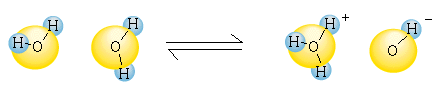
H2O can act as both a proton donor and acceptor for itself. A proton can be transferred from one water molecule to another, resulting in the formation of one hyroxide ion (OH-) and one hydronium ion (H3O+).

2H2O(l) H3O+(aq) + OH-(aq)

This is called the autoionization or dissociation of water. This equilibrium can also be expressed as:

H2O(l) H+(aq) + OH-(aq)

In the above equilibrium, water acts as both an acid and a base. The ability of a species to act as either an acid or a base is known as amphoterism.

The concentrations of H3O+ and OH- produced by the dissociation of water are equal. The corresponding equilibrium expression for this would be:

KC = {[H+][OH-] / [H2O]}

In pure water at 25oC, [H2O] = 55.5 M. Why?

This value is relatively constant in relation to the very low concentration of H+ and OH- (1 x 10⁻⁷ M).

Therefore,

KC = [H+][OH-] / 55.5 M

Rearranging gives:

KC (55.5 M) = [H+][OH-] = Kw
So now we can eliminate [H2O] from the equation and we are left with:

KW = [H+][OH-]

Where KW designates the product (55.5 M)KC and is called the ion-product constant for water. At 25oC, KW is equal to 10-14.

The ion-product constant always remains constant at equilibrium (as the name implies). Consequently, if the concentration of either H+ or OH- rises, then the other must fall to compensate. In acidic solutions, [H+] > [OH-], and in basic solutions [H+] < [OH-].


The pH Scale

Learning Goal 8
Define pH; calculate pH from a knowledge of [H+] or [OH-], and perform the reverse operation.

Rather than expressing [H+] as some very small number, it is often more convenient to describe in terms of pH, defined as:

pH = - log [H+]

For example, a neutral solution at 25oC contains equal concentrations of H+ ions and OH- ions, where [H+] = 10-7M. Thus, the pH of the solution is obtained by:

pH = - log 10-7 = 7

From this it is obvious that at 25oC:

pH < 7 solution is acidic
pH = 7 solution is neutral
pH > 7 solution is basic

Notice that the pH of a solution measures the concentration of dissociated protons, and not the total concentration of acid in a solution.

The negative log scale is useful for measuring other minute quantities, for example to measure [OH-]:

pOH = - log [OH-]

Knowing this, we obtain the following useful expression:

pH + pOH = -log KW = 14.00

The Relationship Between pH and pOH

pH pOH [H+] mol/L [OH-] mol/L
0
14
1.0
10-14
2
12
0.01
10-12
4
10
0.0001
10-10
6
8
10-6
10-8
8
6
10-8
10-6
10
4
10-10
0.0001
12
2
10-12
0.01
14
0
10-14
1.0